Showing posts with label Sales Process. Show all posts

Monday, March 10, 2014

Stop Moaning About the Changed Customer Behavior


We all have read reports about research telling us that people are about 60% or more through their buying process before they first contact a seller. There are organizations using this factoid to propose methodologies allowing the seller to get earlier into contact with potential customers.  This certainly is an option but not the only one.

What has gotten us here?
Before we take action on such a factoid, we should probably know how it was created.  As for most factoids of this type, surveys are used; in this case asking buyers about their opinion how far they are through the buying cycle before getting into contact with a seller.  As there is no commonly accepted definition of a  buying process, we generate an average of subjective opinions. Trying to solve business problems based on averages brings us usually also average (mediocre) results.

However if one has a closer look, the changed customer behavior did not come onto business. Businesses have created it. It is not the internet that has changed customer behavior. The customer has adapted to how businesses use the internet.  More exactly, how marketing functions saw the internet as a new way to push information out to customers. Customers intuitively like this new access to information without having to reveal their identity immediately and not being dependent on a seller as the exclusive access to information.

It is however too easy to put the blame on marketing alone. Seller’s behavior has also its share for changed customer behavior. We all have our stories about when we  felt being manipulated by sellers. So it is no wonder that with new ways to access information, customers tend to steer clear of sellers as long as they can.

Prospecting not being the most favored activity of sellers and their endless complaints about receiving leads of  poor quality have also added that marketing is today so prominent in the customer’s buying cycle by way of marketing automation. With it came new terms and principles such as content- and inbound - marketing as well as qualified, nurtured leads that are supposedly ready to buy. This approach is also considered cheaper than having sellers cold calling to generate leads. In consequence though, marketing automation keeps the potential buyer even longer away from the seller.

What can you do as a sales manager to get your organization there?
Accepting Einstein’s insight that problems cannot be solved with the same thinking that has created them is probably the first hurdle to jump. It will not be without pain because you have to go out of your comfort zone.

Then you should probably get aware of the fact that today’s top sellers approach their job from a point of serving and making a contribution to their customers’ business. Making a quick deal with the next pay check in mind is probably no longer a viable approach. Make though no mistake, closing deals fast is hugely tempting for many salespeople. Put yourself in your sellers’ shoes. If you perceive getting late into the sales cycle and you are told that you are given well qualified leads from marketing combined with the pressure to make your numbers, how would you react? Isn’t it though the seller’s main responsibility to close deals? Yes, but not just closing any deal, especially if customer loyalty is put at risk.

Who do you think will be blamed when a customer, after the purchase, discovers that what was bought does not provide the expected outcome? Humans in business have a tendency to « outsource » mistakes by blaming factors outside of their own control for unpleasant situations.  
So there is a high likelihood that the blame will fall on the company and more precisely on the seller that has sold the solution. The danger that this might happen is bigger than we probably anticipate.

Customers, today, suffer from information overload. They tend to overestimate their competency of gaining the right insights for solving their problems. This opens an opportunity for sellers to add value to cases even though the buyer considers having well advanced in the buying process. A seller with the right mindset can help the customer to gain clarity and choose the right solution to the problem.

Current sales processes are though not built for this type of seller behavior. As a sales manager, you should rethink your sales process. If the sellers are to be able to be of service to their customers and make a contribution to their business, the primary purpose of the sales process has to be the facilitation of the customer’s journey. The factoid that customers have gone through 60% of the journey before contacting a seller is though not a terribly useful starting point for a redesign.  

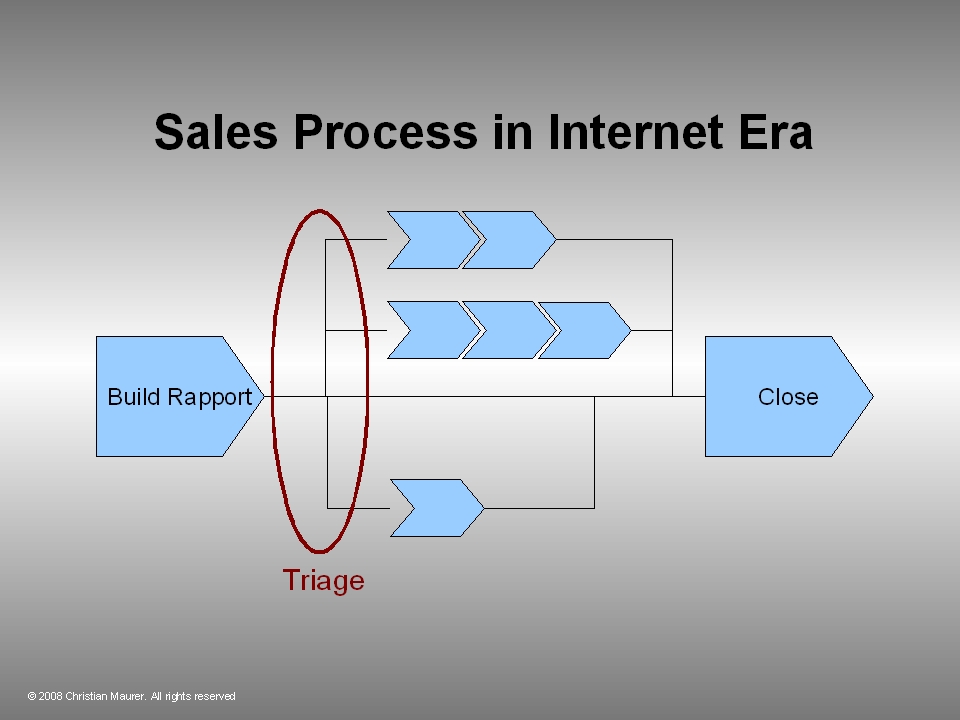
A more valuable insight is to accept that sellers today, when contacted by potential customers or having to act on leads given to them, have a high uncertainty of knowing where the customer is in its journey. A sales process addressing this issue has to provide for a diagnosis as an initial step whenever the customer and the seller get into first contact. The purpose of this step is though not to discover potential pain as so often recommended in traditional sales processes.  It is simply to know where the customer is in its journey. This allows synchronizing the seller’s activities with the customer’s journey. Years ago, I proposed the term Triage for this step. It does not matter whether the first contact is initiated by the seller or the customer.

In many cases, the contact will be established by the seller after having received a lead. For the triage to be effective, sellers must however know what entry point the customer has used to get into contact with your firm. This is the most vital information marketing has to provide when forwarding a lead to sales. This will enable sellers to hold meaningful conversations with their potential customers.

Good cooperation between sales and marketing is required for this information transfer to be effective. This point has been high on the agenda of sales managers for years without much progress being made. Yet, coordinated actions between the two departments have never been as essential for success as now. A way forward in this matter could be to stop haggling about who has the supremacy in facilitating the customer journey. Decisions on who does what should be based on who is perceived as more capable, by the customer, to facilitate the journey to get to the next stage.


Conclusion
An effective response to the changed customer behavior requires sales managers to change their beliefs first and then to execute on improving their peoples’ thinking. The challenges posed by existing sales processes and relations with marketing should then be addressed. It is not knowledge but execution which will provide progress.

Wednesday, February 05, 2014

Don’t throw the baby out with the bathwater


It seems pretty obvious that the profound shifts in customer behavior render traditional sales processes obsolete. Why then do so many managers still insist on the compliance of their people to such processes? Most sales managers perceive any change proposed, on how to assure making their numbers, to be as risky as open heart surgery.  Declaring the death of the sales machine (as a metaphor for the traditional sales process) and proposing more reliance on intuition of the sales people might therefore involve too much risk for sales managers.  They prefer to stay in denial that what got them here will not get them further. Maybe a metaphor comparing the adaptation to the new customer behavior with the evolution from using automates (machine) to using robots might be less daunting.

A robot differs from an automate in two aspects. A robot has sensors to be able to recognize context and is built for agility to adapt to and to act within this context. Automates are built to work only in one context. However, the behavior of robots is still guided by rules and principles programmed into the robot.

The new sensor system for Sales
We first have to accept the fact that a single customer can choose different journeys when purchasing goods and services. As sellers, we need thus to develop a sensor system which allows us to predict which journey  the customer is going to choose,  to recognize evidence on what journey the customer is on and where the actual position in this  journey is.    

This implies that we have a set of standards, allowing us to determine the customer evidence needed to answer those questions in an unambiguous way within an entire sales organization. Checking the adherence to these standards, instead of asking for compliance to a given sales process, is then the new foundation for managers to assess whether they will make their numbers. To assure managers that such an approach will work, we can find evidence in research from CSO Insights which shows that continual tracking of customer behavior leads to higher forecast accuracy. This sensor system is actually implemented through comprehensive diagnostics going much beyond the simple process of just probe for a pain in order to be able to offer a solution.

Using principles to achieve agility in Sales
Within a customer journey, there are still logical sequences - the very characteristic of the existence of a process. Ignoring these sequences will have a detrimental impact on the outcome of a sales effort. However spelling out these sequences on the level of granularity of individual activities is ineffective. Therefore, we should work on the level of principles which allow for flexibility on choosing the activity best suited to perform on these principles.  This will Increase the agility of the sales organization.

The sensor system will be used helping sellers in selecting the right sequences of principles that should be applied. By using the proper sequence of principles, the seller can provide added value in guiding the customers through their different journeys. This increases the likelihood of winning the deal. Customers tend to decide in favor of the offering of the sales person having provided the most added value in the journey.

Here is a proposed list of such principles: Rapport Building, Triage, Pain Creation, Vision Engineering, Vision Re-Engineering, Establishing Confidence that expected business outcomes can be obtained with the proposed offering and Value Confirmation.  Triage might be an expression needing some clarification. It is used, prior or during the initial customer interaction for a single sales case. It determines the customer’s choice of the journey and the position within that journey.    Triage, Pain Creation, Establishing Confidence and Value Confirmation are needed in this exact order to help navigate through any customer journey.

The need for Rapport Building is limited to situations where no relationship exists yet between the seller and the buyer. If used, it must precede Triage. Value Engineering or Value Re-engineering are also only relevant as alternatives in some journeys. Value Engineering is needed for customers who have not spent any money neither with us nor the competition for a particular category. Value Re-engineering is used when the customer has spent or currently spends money with competitors for a category where we have to offer viable alternatives. It is also used when we recognize that the customer has adopted a vision before our initial contact with them.  To make the right choice on the alternative, Triage is a prerequisite.

On the level of these principles, there is no freedom what needs to be done when. There are also clear rules when and how to use optional principles. This provides a framework for managers how to coach their salespeople on the application of those principles. In this coaching framework, there is room for intuition when determining the actions on how to best execute on the principles.

Conclusion
Given today’s Customer behavior, replacing the classical sales process by a framework based on standards and principles helping us to become more agile within a well understood context, seems a viable alternative to throwing out the sales machine and depend on more intuition. Establishing this framework however does not guarantee success. Competencies of salespeople and particularly sales managers must equally be augmented for successful execution. The framework helps however to understand the capability gaps.

This article appeared first in the December 2013 issue of Top Sales World Magazine


Thursday, January 24, 2013

Commercial Sales Methodologies are evolving at a slow pace


Yesterday, I attended a presentation about Sales Performance International's (SPI  new “Solution Selling 2.0” program.
  
The one and only sales process does no longer exist
From what I heard, I think “Solution Selling 2.0” might help sellers to be more effective to help customers in their buying process.  I found most interesting that the company, probably owning the most process oriented commercial sales methodology, had to concede that in today’s world,  using one and only one sales process is no longer effective. I could not help to chuckle when I heard this. I had already written about the need for a multiple process approach in 2008.
Since then, others, such as McKinsey have shown that the customer buying process are different in function of customer loyalty (McKinsey Quarterly 2009 No2.)  Also for quite some years,  CSO insights consider that best in class companies have a dynamic sales process. Which to me indicates that also they consider that a one size fits all approach is no longer effective. 

Implications for Sales Management
The need for several sales processes  increases complexity for sales management. It is no longer sufficient to inspect that the sales process is followed. Managers now need to be able to inspect that the most suitable process is followed. While the design of these different processes can be delegated (e.g. to sales operations), managers must be able to judge which process is the most suitable for a given buying situation. Universally applied criteria for the selection of the right process must be defined and applied.

The need for an outside-in view
To come to meaningful selection criteria for the appropriate sales process, a mapping to the customers buying process is fundamental.  It is relatively simple to see if the customer buying process is considered in the sales process.  I usually look how sales stages (the top level definition of a sales process) are labeled in the CRM system. If you do not find any terms reflecting the customer situation, then there is a high likelihood that your sales process is internally focused. You would be surprised how often you still find this situation in running CRM implementations.  If you find yourself in this situation an effort must be made to understand the customer’s buying behavior (outside in) before even contemplating to move to a set of various sales processes.

Call for action
Moving towards various sales processes to be more responsive to different customer situations is a change management process. Sales Leaders and Mangers are the first targets who must adhere to this change.  Are you as leaders and managers willing to make this effort?

Wednesday, January 05, 2011

It is counterintuitive but it works


As a person who believed that the velocity with which a lead converts to a deal is not considered enough, I was skeptical whether the book Slow Down, Sell Faster! by Kevin Davis would work for me. This skepticism did not last long. Once I understood that the title of the book recommends that the rhythm of selling should fit to how customers want to buy, I felt comfortable. I am of the belief that sales velocity should be measured by how fast milestones in the buyer’s journey are reached, not how fast sales activities are carried out. My comfort with the contents of the book continued to increase the further I read it.

In the first part of the book, Davis suggest an eight step circular buying process model providing guidance for sellers, what to do and whom to access within the customer organization to help the customer navigate through his/her journey of buying. I appreciate that he does not promote this model as a one-size-fits-all approach to success. To the contrary, he makes it perfectly clear that his model is focused on “buy-learning” where potential customers do not yet have all the necessary information to make a buying decision, compared to “buy-knowing” where buyers can make a decision quickly because they already know as much as they need to make a decision.

To make the model actionable for sellers, Davis assigns a metaphor of real professionals to each of the eight phases. These metaphors describe the ideal behavior of a sales person to help the buyer move through the respective phase. Here is an illustration of the concept: The first phase in the buying process is labeled “Change.” The sales role best suited to facilitate the buying process at this stage is “Student,” someone who is learning about changes affecting a potential customer. In the following “Discontent” phase, the appropriate sales role is that of a “Doctor,” a person who diagnoses the cause of the discontent, and so on.

-Davis’s model includes two phases after the customer’s buying decision, reflecting his belief that the purpose of selling is not closing a deal but opening a relationship

These sales roles metaphors illustrate well what a successful seller needs to do in the different phases of the buying process. However there is a danger of confusion if your company’s job description uses some of these same labels in different ways.

The remaining chapters of the first part of the book deal with the major aspect that make a deal complex: the fact that there are several people involved in the buying decision, each having different roles. As Davis’s book is based on seminars he teaches, it is understandable that specific jargon is used to describe the various roles in the buying team. I particularly liked the concept of the power broker. I am less sure about the role of the ROI authority, the person who can make funds available and is the ultimate decider. I am sure the role exists and is crucial, I am just not so sure about the label.

The buying team roles are then mapped to where and how they are most likely involved in the eight step buying process model, thus giving the sales person guidance when best to speak to whom. Combining the roles of the buying team and the buying process makes it very clear why “calling high” is not as sure a recipe for success as many sales experts want to make us believe.

The second part of the book then describes the sales roles of “Student,” “Doctor,” etc., in detail. With real-life examples the model is brought to life. In those examples, there are some details where old salesmanship shines through. But this does not in any way diminish the value of the concepts which are leading edge thinking of how to approach selling in the 21st century.

With the third part of the book, Davis demonstrates his expertise on how a sales team can be introduced to the new thinking he is suggesting. Sales managers play a crucial role in such initiatives. The book also covers the aspect how managers can use the eight sales roles as a very effective basis for coaching their people and thus make sure that the concepts are applied to greater sales success.

Davis is obviously someone who carried a bag in the field. However, unlike many others, he is able to conceptualize his experiences to make them comprehensible to others. The book is definitely not of the category “this is what I did and I see no reason why you should not be successful doing the same.” Instead it provides a very good framework for sales organizations wanting to remain successful in this new era, where customers have much more power than salespeople have been used to.

Tuesday, March 09, 2010

'Sales Process' Is In The Air

There is a lot written about the sales process these days:

  • Dave Brock has written several pieces on the sales process recently. He now has launched an initiative to get some new thinking on the subject by asking “What's the Future of Buying”.

  • I have seen several contributions by Sharon Drew Morgen, besides her new book 'Dirty little Secrets...', reminding us that we should stop talking about selling and trying to understand to the extent possible how people and organizations buy.

  • Ardath Albee in her book “eMarketing Strategies for the Complex Sales” proposes a marketing flavored look on the buyer's journey. A particularity of her model is that it does not imply a linear process as most others do.

  • Axel Schultze wrote in a recent blog post that our sales processes are old and suck.

  • There is a Discussion going on on LinkedIn for several weeks now about what the right steps of a sales process are.

  • Sales 2.0 Network now offers Dealmaker Genius helping to design your sales process in 15 minutes for free.

  • Landslide has a similar offering for building a sales process. So these people believe that this task can even be automatized.

  • Then there are those who still believe selling is an art and therefore cannot be captured in a process.
This list is certainly only capturing the proverbial tip of the iceberg of what can be found in recently published books, on social networks, on blogs etc..

Why now?
I think we are seeing signs of a perfect storm forcing us to rethink professional selling:

  • Despite massive investments for many years in CRM systems, in the design and implementation of sales processes, in training initiative on sales methodologies and selling skills for , sales performance is probably at its lowest since CSO Insights started tracking it some 15 years ago?

  • Current economic conditions do no longer allow us to continue with such investments even though they seem to be needed more than ever.

  • Web 2.0 has shifted the negotiation power clearly in favor of the buyer.

  • Marketing makes claims to be more involved in the revenue gen process wanting to manage and qualified leads when they are 'ready to buy'.

  • There is an ever growing number of tools under the Sales 2.0 acronym suggesting they can improve sales performance.

Some new thinking to weather the storm
The customer's buying journey has to be taken as a given. With the model of looking at the complex buying journey as a change management process I have helped my customers to get a lot of clarity. The focus is thereby not so much on the activities the buyer undertakes, but the intermediate decisions taken to finally arrive at the buying decision. The journey though does not end there. We should not ignore that the buyer then will also decide whether the value promised with the purchase was also delivered. As was pointed out in a recent article in the McKinsey Quarterly, this notion will be essential how the buyer's journey will look the next time it is started by a trigger.

It is probably also save to assume that increasing sales performance will need tighter collaboration between sales and marketing. Talking about a sales process alone will therefore be of little help. As we see the term Chief Revenue Officer emerge for the person who oversees this collaborative working of sales and marketing to generate revenue streams, the term Revenue Generation Process might help us to define what we will need instead.

What do we want the Revenue Generation Process to do?
There will be a lot of debate on the purpose as there is with the sales process.
Attempts to make it a recipe book, prescribing the activities sales and marketing have to undertake for generating revenue, will fail. For me the Revenue Generation Process should do the following:

  • Get the sales and marketing organization to have have a common understanding where a buyer is in its journey based on observable reactions from the buyer.

  • Define accountability for sales and marketing along the customers journey.

  • Stimulate forward looking discussions on how best to pursue a lead/opportunity (i.e. next best actions to help the buyer to make the next decision, recycle a stalled or lost opportunity, abandon a lead/opportunity or a buyer)
As a byproduct, such a Revenue Generating Process, will also provide better forecasting and indications where sales and marketing people will need coaching to improve performance.

The role of the sales person in the Revenue Generation Process?
For salespeople to be successful and provide value within this framework, they need to be very versatile. The buyer's need for help will determine when they will be involved in the process. This might be as early as helping the buyer to identify pain, or starting at helping to formulate a vision how to get remedies for the pain (solution). In other cases, there first buyer contact will be helping validate a solution the buyer has already envisaged on its own or even later helping to hedge cost and risk to find the best vendor. We will also have to accept, that there will be a growing number of situations, where salespeople cannot add value to the buyer and should therefore not be involved at all.

For the involvement of a salesperson to be effective, marketing, already involved in the revenue generating process must though make sure that full access to the information how the buyer has arrived at this point of first contact. Even if marketing is qualifying leads based on observable buyer's actions (click through, surf path on web site, social media interactions, webinar attendance, white paper requests etc.) this information must be available to the salespeople so they can provide maximum value at their point of contact with the buyer.

Salespeople, in return, must provide a protocol of all their interactions they have undertaken, in case a lead/opportunity is returned to marketing for recycling or nurturing. Then marketing can decide on the most effective campaigns to help the buyer to come to a point where contact with the salesperson is needed again to continue the buyer's journey.

Implementing a Revenue Generation Process.
For a successful implementation of such a process including the support by adequate systems, a fundamental mind shift will be needed from all involved. Transparency and accountability must be the norm for such a Revenue Generation Process to produce results. To get to the needed transparency, trust between those involved is required. This is a particular challenge for the leadership up and including the C-Suite. In many cases, this will mean first abandoning old management practices which currently cause reluctance with salespeople in many organizations to share information in the detail needed for a successful implementation of a Revenue Generation Process.

What are your thoughts on this? What have I forgotten? Where am I wrong? Which view do you share?

References:

I am not a regular blogger you migth want to receive new articles per e-mail

Enter your email address:

Delivered by FeedBurner

Most Popular Posts (last 7 days)

Blog Archive