Showing posts with label Sales Management. Show all posts

Friday, June 05, 2015

The New Account Sales Challenge: The 5 Ugly Questions Helping You to Protect the Health of Your Business


In the CSO Insights 2015 Sales Performance Optimization study, “capturing new accounts” made it to the top of sales objectives for 2015.  Kim Cameron recently published a post “Overcoming the New Account Sales Challenge” here.

Before addressing the valid challenges, mentioned in Kim’s blog, you should though make sure that your initiative of “capturing new accounts” eventually does not hurt your business by causing these undesired effects:
·         Expected growth targets are not met
·         Profitability drops
·         Customer satisfaction drops

The 5 Ugly Questions
This list of questions can help you to diagnose whether your “capturing new accounts” initiative might negatively affect the health of your business.
1.       Have you clearly defined the ideal accounts you want to capture?
The lack of this definition exposes you to all three undesired effects. In absence of such a definition, salespeople will decide on their own, where to go hunting and the chances are high that they miss the attractive accounts.
More information on this phenomenon can be found in Frank V. Cespedes excellent book   Aligning-Strategy and Sales

2.       Is an adequate value proposition available for these ideal accounts?
In absence of such a definition especially profitability and customer satisfaction are endangered.

3.       Do you know how many of the ideal accounts have never before bought the category you want to sell to them?
Not knowing the answer to this question can particularly hamper profitability.  Furthermore it might take longer for your initiative to meet the expected growth targets.  
Accounts, never having bought the category you want to sell to them, have a different customer journey than accounts that are new only to you but have previously bought the category from competitors. Therefore, you need different strategies matching the respective customer journey.
In the first case you can gain market share if you can penetrate the account by facilitating the “buy learning” journey.
In the second case, you have to displace the incumbent competitor (“buy wallet share”).  Displacement of incumbent competitors most often results in price wars.
If your company does not have an operational excellence strategy in place, which provides for a systemic and sustainable lower cost structure, profitability is highly endangered.
Product superiority with according value propositions is another alternative to displace incumbent competitors without risking your profitability level.

4.       If you have to attack accounts held by incumbent competitors, do you now their purchasing strategy?
Ignoring this question can lead to overoptimistic growth expectations. Many purchasers follow dual vendor strategies. They know that for remaining a valuable account to the second vendor, they have to leave them a part of the wallet share attractive enough so the vendor does not “fire” the account.

5.       The follow on question then is: Does your expectation of the wallet share you must aim for, so the account is attractive to you, match with what you can realistically expect given the competitive situation in the account?
Knowing the answer to this question makes you more selective of the new accounts to pursue and is the basis for setting realistic growth targets.

Conclusion
In absence of a company strategy, where ideal customers, appropriate value propositions, market saturation level, competitive strategies and purchasing strategies of the ideal customers are known and aligned, “capturing new accounts” risks to be detrimental to the health of your business.

Call to Action
Answer the 5 ugly questions. They are ugly because you might come to the conclusion that “capturing new accounts” is actually a less attractive objective than you had hoped for.  You might then be motivated to find more suitable alternatives to grow the top line without jeopardizing the health of your business.
Should you need help, you can give me a call.

Thursday, April 30, 2015

What is a reasonable number of contacts in your social network (2)?


This is the second post based on a keynote I presented at the 10th annual RiiM conference in Paris on the beginning of April 2015.

The previous post looked from an anthropological perspective for clues how to find the right balance between the quantity of contacts and the quality of relations. In the age of Social Selling, imbalances can lead to wasted efforts and mitigated results.

The neuroscience perspective
A monkey or ape belongs to a social network if it maintains grooming relations with other members of a clan. The main reason for maintaining grooming relations is however not to keep it each other’s fur clean. The action of grooming releases endorphins which are a “feel good” hormones. For humans verbal exchanges can have the same effect.

A researcher in California has discovered in one experiment that human interactions via electronic “social networks” release oxytocin, also known as “cuddle hormone” thus causing “good feelings”. Interactions in cyberspace can thus have similar effects as interaction in physical social networks. Physical proximity and the unity of the moment for the exchange seem thus not to be a prerequisite to produce the “good feeling”  From this perspective, human interactions in physical and electronic social networks can be of similar quality

In another study, a correlation was found between the use of electronic “social networks” and the concentration of gray matter in three areas of the human brain. These three areas are though different from the areas being active when having interactions with physical social networks. With their findings, the researchers are though faced with a chicken and egg problem. Does the concentration of gray matter enable the use of electronic “social networks” or causes the size of the electronic “social network” an increase of the gray matter in these areas. As mentioned in the in the last post, we therefore cannot yet answer the question whether the cognitive limits determining the  size of physical social networks can be overcome with electronic “social networks”.

Why does this matter?
Skeptics might jump on the discovery that the use of electronic social media releases the “cuddling hormone” and will see the danger that the use of electronic “social networks” can cause addiction and can thus negatively impact work productivity.  We touch here also on a generation issue.

For Millennials, who grew up with those electronic tools, the danger might be considered as particularly high. A recent article on the HBR Blog however, suggests a positive interpretation of the oxytocin effect. We might have to take into consideration that the oxytocin effect makes Millennials, through their use of electronic platform, to natural team workers.  Millennials, at the stage of their brain development, seem also to have a higher tolerance and a higher integration capacity of multiple streams of information. The tools (smart phones, tablets etc.) that Baby Boomers might see as elements of distraction, are considered enablers for collaborating and innovating in real-time by Millennials.   
As a lecturer in a Master program for Strategic Sales Management at a German business school, I remember a recent anecdote to this effect. One evening, around 10 p.m., one of the groups, discovered, that they were missing a photo of an essential flip chart we had developed in class a few weeks earlier. As this hindered their progress on a work assignment, they used WhatsApp for an enquiry with their other class mates geographically dispersed over Germany. They were able to find the missing photo within less than 10 minutes and also proudly told this to me (a Baby Boomer).

What are the consequences for sales managers?
Millennials are getting things done differently than Baby Boomers. Teams composed exclusively of Millennials should therefore be held accountable for the outcome of their activities. How to get to the outcomes should though be their free choice.

The successful interaction between Millennials and Baby Boomers being it in customer-seller or in work relations poses some coaching challenges:
  •  Millennials are more willing to share information and to collaborate. In interaction with Baby Boomers, they are very sensitive about the reciprocity of sharing. If they feel their willingness to share is abused, collaboration will become difficult. Young sellers have confide to me that they often feel that older colleagues tend to abuse their willingness e.g. to share customer contacts. They also feel that older colleagues hide information from them.
  • Millennials tend to use electronic “social networks” at a higher intensity. As long as we do not have scientific evidence that human brains can adapt to larger electronic “social networks”, intensive users of social networks and Millennials in particular, need to be monitored for distraction effects which can hamper work productivity. Should negative impacts on productivity occur, we should keep the Dunbar number as a guideline for the amount of people with whom they interact frequently in electronic “social networks”.
  • Millennials need guidance for productive interactions with Baby Boomers.  In my experience with my students, I found that they are more receptive to systemic approaches focused on the underlying mechanics of human interactions than on simple recipes how things should be done. They are interested in the “Why” and doubt whether just imitating “How” Baby Boomers do, or have done it, is still an effective approach in the rapidly changing world.  

Friday, April 17, 2015

What is a reasonable number of contacts in your social network?


Photo credit  Noneotuho CC BY-SA 3.0 (http://creativecommons.org/licenses/by-sa/3.0), via Wikimedia Commons  

This post is based on a keynote I presented at the 10th annual RiiM conference in Paris last week.

Why should you care?
The above question actually implies the search of the right balance between the quantity of contacts and the quality of relations. In the age of Social Selling, imbalances can lead to wasted efforts and mitigated results.

A look into statistics
The average number of contacts maintained by a user of LinkedIn was recently reported as being 60 contacts. For Facebook, I found an average of 350 contacts. The median values are in both cases significantly higher indicating that the distribution curves are skewed and averages are not very conclusive. I therefore reverted to what I have learned as an engineer. An engineer can only create successful constructions if he/she respects the limits of the material used for the construction. This leads though to the question what is the material of a social network? It is not servers, software applications, PC’s, tablets, smart phones nor bandwidth. A social network is first and foremost created among humans.  So who could know about whether humans have limits regarding the size of the social network they can handle? Anthropology and Neuroscience seemed to me possible sources to search for an answer.

The anthropological view
Anthropologists study social networks not only since we have electronic social networks. It did not take me long to stumble over the Dunbar number which says that humans can manage at one given time a social network consisting of about 150 members.
  
Robin Dunbar a, British evolutionary psychologist found this number through two totally different studies. First, he found that for primates (monkeys and apes) there is a correlation between the relative size of the neocortex compared to the rest of the brain and the size of the social network the different species can maintain. Extrapolating this curve to the human race, he concluded that humans can maintain social networks of about 150 members.

How can the size of the social network of primates be measured? For the monkeys and apes it is the number of grooming relations and individual animal maintains. This metric obviously cannot be applied to humans.

To verify the extrapolated number, Dunbar observed how humans send Christmas cards (before the electronic media time). Maintaining a relation through sending Christmas cards requires a certain effort. The postal addresses of the targets must be kept up to date, cards and stamps have to be bought and the cards need being written and then taken to a post box. This effort is taken as a substitute of the grooming efforts primates invest in maintaining their social network.  Dunbar found that an individual human sends out Christmas card so that about 150 people can be reached.

Dunbar also offers a simple rule thumb how to determine the size of someone’s social network. “150 is the number of people you would not feel embarrassed about joining uninvited for a drink if you happened to bump into them in a bar.”


Preliminary conclusions
Compared with the size of physical social networks, many people maintain oversized electronic “social networks”.  This raises the interesting question whether electronic platforms allow us to overcome the natural limits imposed for the size of physical social networks? As we will see later, this cannot be totally excluded but we certainly do not have enough scientific evidence to answer with a firm yes.

I suspect that the relations listed on those electronic platforms do not have the quality level requested to be qualified as social network connection in the traditional sense.  The number of people we know is evidently larger than the number of relations of social network quality level we maintain. Those platforms are thus more used as store for our address lists or a 24/7 asynchronous networking event or distance independent chat at the virtual “coffee corner”.  They can though also contain at least a part of our social networks.

Why does this matter?
In the age of Social Selling, there is a danger that sellers might unconsciously try to mimic physical social network behavior to a much larger number of individuals in electronic “social networks”. In our data driven world the number of connections could also become a simple numbers game. Both these effects result in distraction and wasted efforts.

Electronic tools certainly improve efficiency but only their intelligent use provides effectiveness. The effort to arrive at effective Social Selling might be underestimated and thus lead to unsatisfactory results. The reach of messages disseminated through “social networks” might also be overestimated. Deliberately following someone on an electronic “social network” takes some effort.

Sales Management needs thus to coach sellers to make productive use of these tools.  Thereby it  is less the total number of contacts in their respective electronic “social network” than the number of relations where a high intensity is maintained that matters and can negatively impact performance.

I will present what I found from a neuroscience point of view in a next blog post.

Monday, March 10, 2014

Stop Moaning About the Changed Customer Behavior


We all have read reports about research telling us that people are about 60% or more through their buying process before they first contact a seller. There are organizations using this factoid to propose methodologies allowing the seller to get earlier into contact with potential customers.  This certainly is an option but not the only one.

What has gotten us here?
Before we take action on such a factoid, we should probably know how it was created.  As for most factoids of this type, surveys are used; in this case asking buyers about their opinion how far they are through the buying cycle before getting into contact with a seller.  As there is no commonly accepted definition of a  buying process, we generate an average of subjective opinions. Trying to solve business problems based on averages brings us usually also average (mediocre) results.

However if one has a closer look, the changed customer behavior did not come onto business. Businesses have created it. It is not the internet that has changed customer behavior. The customer has adapted to how businesses use the internet.  More exactly, how marketing functions saw the internet as a new way to push information out to customers. Customers intuitively like this new access to information without having to reveal their identity immediately and not being dependent on a seller as the exclusive access to information.

It is however too easy to put the blame on marketing alone. Seller’s behavior has also its share for changed customer behavior. We all have our stories about when we  felt being manipulated by sellers. So it is no wonder that with new ways to access information, customers tend to steer clear of sellers as long as they can.

Prospecting not being the most favored activity of sellers and their endless complaints about receiving leads of  poor quality have also added that marketing is today so prominent in the customer’s buying cycle by way of marketing automation. With it came new terms and principles such as content- and inbound - marketing as well as qualified, nurtured leads that are supposedly ready to buy. This approach is also considered cheaper than having sellers cold calling to generate leads. In consequence though, marketing automation keeps the potential buyer even longer away from the seller.

What can you do as a sales manager to get your organization there?
Accepting Einstein’s insight that problems cannot be solved with the same thinking that has created them is probably the first hurdle to jump. It will not be without pain because you have to go out of your comfort zone.

Then you should probably get aware of the fact that today’s top sellers approach their job from a point of serving and making a contribution to their customers’ business. Making a quick deal with the next pay check in mind is probably no longer a viable approach. Make though no mistake, closing deals fast is hugely tempting for many salespeople. Put yourself in your sellers’ shoes. If you perceive getting late into the sales cycle and you are told that you are given well qualified leads from marketing combined with the pressure to make your numbers, how would you react? Isn’t it though the seller’s main responsibility to close deals? Yes, but not just closing any deal, especially if customer loyalty is put at risk.

Who do you think will be blamed when a customer, after the purchase, discovers that what was bought does not provide the expected outcome? Humans in business have a tendency to « outsource » mistakes by blaming factors outside of their own control for unpleasant situations.  
So there is a high likelihood that the blame will fall on the company and more precisely on the seller that has sold the solution. The danger that this might happen is bigger than we probably anticipate.

Customers, today, suffer from information overload. They tend to overestimate their competency of gaining the right insights for solving their problems. This opens an opportunity for sellers to add value to cases even though the buyer considers having well advanced in the buying process. A seller with the right mindset can help the customer to gain clarity and choose the right solution to the problem.

Current sales processes are though not built for this type of seller behavior. As a sales manager, you should rethink your sales process. If the sellers are to be able to be of service to their customers and make a contribution to their business, the primary purpose of the sales process has to be the facilitation of the customer’s journey. The factoid that customers have gone through 60% of the journey before contacting a seller is though not a terribly useful starting point for a redesign.  

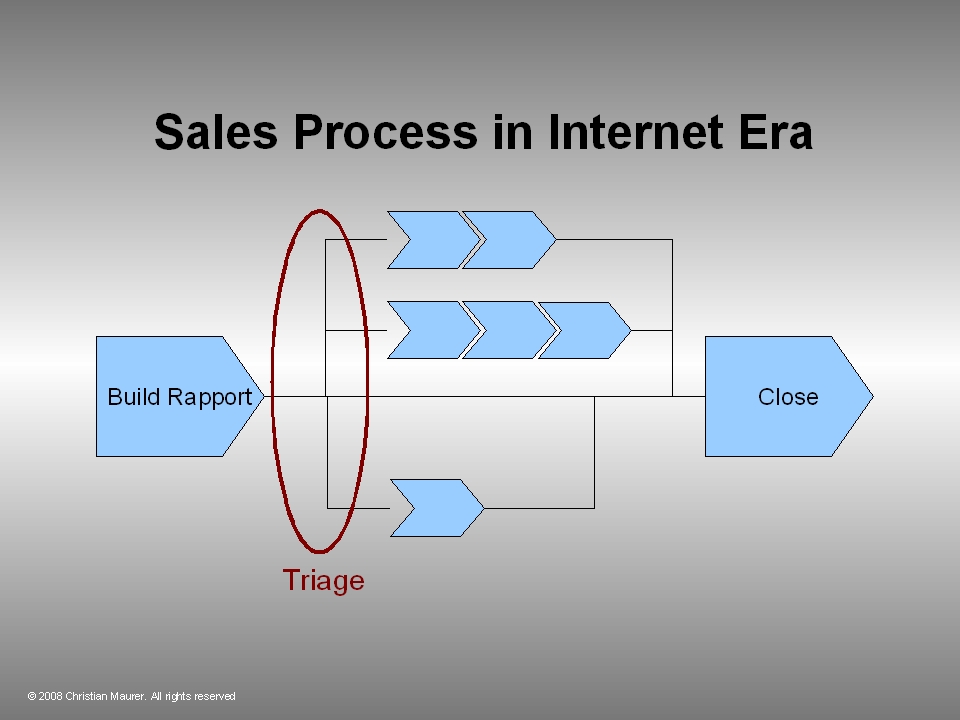
A more valuable insight is to accept that sellers today, when contacted by potential customers or having to act on leads given to them, have a high uncertainty of knowing where the customer is in its journey. A sales process addressing this issue has to provide for a diagnosis as an initial step whenever the customer and the seller get into first contact. The purpose of this step is though not to discover potential pain as so often recommended in traditional sales processes.  It is simply to know where the customer is in its journey. This allows synchronizing the seller’s activities with the customer’s journey. Years ago, I proposed the term Triage for this step. It does not matter whether the first contact is initiated by the seller or the customer.

In many cases, the contact will be established by the seller after having received a lead. For the triage to be effective, sellers must however know what entry point the customer has used to get into contact with your firm. This is the most vital information marketing has to provide when forwarding a lead to sales. This will enable sellers to hold meaningful conversations with their potential customers.

Good cooperation between sales and marketing is required for this information transfer to be effective. This point has been high on the agenda of sales managers for years without much progress being made. Yet, coordinated actions between the two departments have never been as essential for success as now. A way forward in this matter could be to stop haggling about who has the supremacy in facilitating the customer journey. Decisions on who does what should be based on who is perceived as more capable, by the customer, to facilitate the journey to get to the next stage.


Conclusion
An effective response to the changed customer behavior requires sales managers to change their beliefs first and then to execute on improving their peoples’ thinking. The challenges posed by existing sales processes and relations with marketing should then be addressed. It is not knowledge but execution which will provide progress.

I am not a regular blogger you migth want to receive new articles per e-mail

Enter your email address:

Delivered by FeedBurner

Most Popular Posts (last 7 days)

Blog Archive